


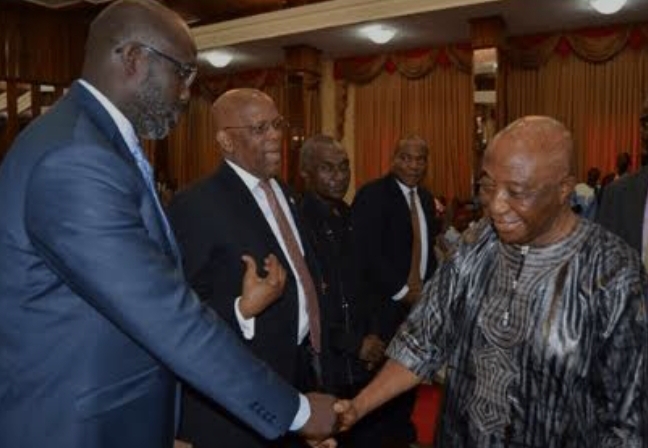
Liberian President, George Weah, has conceded election defeat to opposition leader, Joseph Boakai.
The 57-year-old football legend lost to 78-year-old former Vice President Boakai, who he defeated in the 2017 election with 62 percent of the votes.
He accepted the result, which showed that his opponent led with 50.9 percent of the votes to his over 49.1 percent of the votes.
Weah, defeated with 28,000 votes, on national radio, said, “Ladies and gentlemen, tonight the CDC has lost the election, but Liberia has won. This is the time for graciousness in defeat, to put national interest above personal interest.
“The Liberian people have spoken, and we have heard their voice. However, the closeness of the results reveals a deep division within our country.
“A few moments ago, I spoke with president-elect Joseph Boakai, to congratulate him on his victory.
“I urge you to follow my example and accept the results of the elections,” he added.
Weah’s concession paves the way for Liberia’s second democratic transfer of power in over seven decades – the first was when Weah swept to power six years ago.
His comments stood out in West and Central Africa where there have been eight military coups in three years, eroding faith in democratic elections. When elections do go ahead in the region, accusations of fraud abound and results are frequently contested in court.
Instead, Boakai supporters in the capital Monrovia danced, shouted and honked car horns in the rain after the near-final results were announced.
“We have a job ahead of us to do and I’m excited that the citizens have given us approval,” Boakai told Reuters shortly after the results were announced. “First and foremost, we want to have a message of peace and reconciliation.”
Boakai, a softly spoken career politician, emerged neck-and-neck with Weah in the first round of voting in October but below the 50 percent needed to secure an outright victory, leading to Tuesday’s run-off.
Liberia is struggling to recover from two civil wars that killed more than 250,000 people between 1989 and 2003, and from a 2013-16 Ebola epidemic that killed thousands.
Many felt that Weah did not follow through on promises to alleviate poverty and improve the country’s crumbling infrastructure.
Arkoi Sarkor, 43, told Reuters she supported Boakai because she was not able to get a job during Weah’s term.
With additional reports from Reuters
